



The Science of Cervical Alignment: How to Correct Pillow Height, Density, and Sleep Posture
The Science of Cervical Alignment: How to Correct Pillow Height, Density, and Sleep Posture
Waking with chronic neck stiffness, shoulder impingement, or tension headaches is frequently dismissed as an inevitable consequence of stress or aging. Yet in ergonomic and restorative sleep medicine, the diagnosis is often far more immediate: your pillow has failed its fundamental biomechanical assignment. Rather than supporting your body’s natural anatomy, a depleted or incorrectly calibrated pillow forces your cervical spine into unnatural lateral flexion or forward tilt for hours every night.
Solving chronic sleep discomfort does not require medical contraptions or rigid contour contraptions. It requires mastering the physics of head support—specifically, understanding how sleeping position, shoulder width, and fill density interact to preserve neutral spinal alignment. Here is the designer and sleep-science guide to calibrating your pillow architecture for restorative, pain-free sleep.
1. Step 1: Diagnose the Misalignment (The Mirror Test)
Before adjusting your bedding, identify your cervical deflection point. Neutral spinal alignment means your ear, shoulder, and hip form a clean, continuous horizontal axis when viewed from the side.
-
For Side Sleepers: Lie down on your side in your typical resting posture and have someone take a photo from head to foot. If your nose points downward toward the mattress, your pillow is underfilled, collapsing your neck into downward compression. If your nose points upward toward the ceiling, your pillow is too thick or stiff, creating upward hyper-extension.
-
For Back Sleepers: Your pillow should cradle the natural lordotic curve of the neck without pitching your chin toward your chest. If swallowing feels restricted or your airway feels slightly narrowed, your pillow loft is excessively high.
2. Step 2: Calibrate Your Required Loft by Sleep Position
The volume of space between your head and the mattress—known as the "cervical gap"—varies dramatically depending on how you sleep. Correcting posture requires calculating your exact loft profile:
-
The Side Sleeper Profile (High Loft, High Density): Side sleeping leaves the largest anatomical void—the distance from the tip of the acromion process (shoulder bone) to the side of the neck. You require a firm, high-loft pillow (typically 5 to 6 inches under compression) with high fill density to prevent your shoulder from bearing the entire weight of your torso.
-
The Back Sleeper Profile (Medium Loft, Adaptive Density): Back sleepers require a medium loft (around 3 to 4 inches) with a responsive core that fills the hollow beneath the cervical vertebrae while allowing the occipital bone to sink back naturally.
-
The Stomach Sleeper Profile (Low Loft, Malleable Fill): Stomach sleeping places intense rotational torque on the neck. If you cannot transition to side or back sleeping, use an ultra-low loft insert (2 to 3 inches) that prevents cervical backward bend.
3. Step 3: Match Core Material to Anatomical Resistance
A common error is confusing surface softness with ergonomic support. A pillow may feel cloud-soft when your head first touches it, only to bottom out completely two hours later as body heat and weight compress the core.
-
Natural Feather & Down: Best suited for back sleepers who need fluid contouring. Feathers provide a spring-like micro-scaffolding, while surrounding down cradles the curve of the neck.
-
Organic Kapok: Ideal for side and back sleepers seeking botanical purity with resilient, buoyant resistance. Its hollow-fiber structure provides dense, cloud-like loft that will not pack down or flatten during the night.
-
Micro-Denier Down-Alternative: Exceptional for those requiring consistent, hypoallergenic cervical lift. Fine-filament synthetic cores maintain uniform density edge-to-edge without creating pressure points against the ear or jaw.
4. Step 4: The Nightly Spinal Reset Protocol
Even an ergonomically calibrated pillow requires daily mechanical redistribution to perform consistently. Natural and clean synthetic fibers naturally shift away from the primary weight-bearing center toward the outer perimeter seams.
Each evening before retiring, grasp your sleeping pillow by its short ends and accordion-compress it inward firmly three times. Then, smooth the center out with a gentle, downward press of your palm. This draws loft back to the central cradle, ensuring that the moment your neck makes contact, the core provides immediate, calibrated resistance precisely where your spine needs it most.
The Looms & Linens Difference
True ergonomic restorative sleep requires uncompromising internal density. Lightweight, underfilled consumer pillows quickly surrender to head weight, abandoning your neck to improper posture and morning aches.
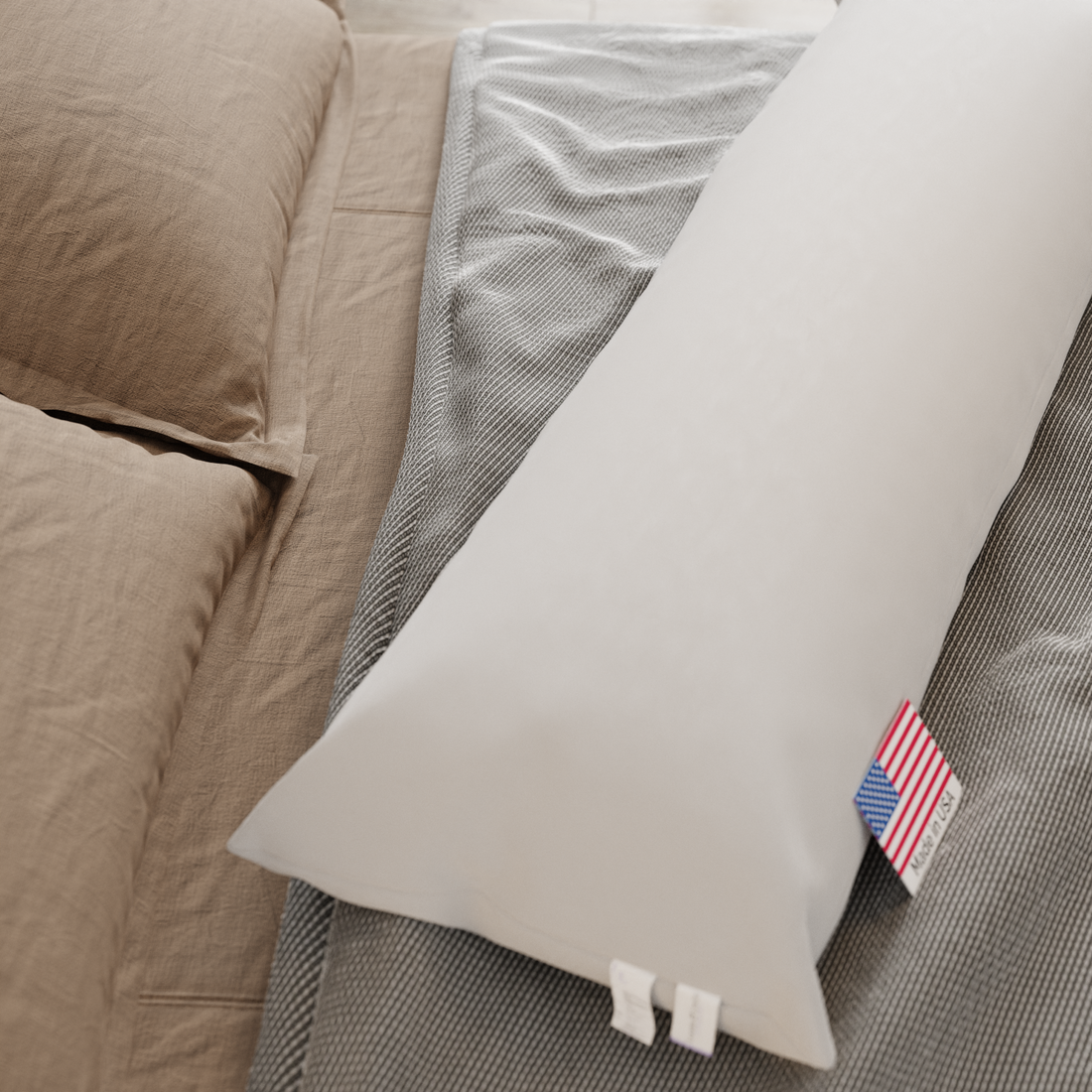
Looms & Linens high-density pillow inserts—meticulously crafted in the USA in Down-Alternative, GOTS-Certified Organic Kapok, and Feather blends—are calibrated with generous overfill weights engineered to provide enduring cervical support. Encased in high-thread-count, migration-proof cotton shells, our cores deliver the exact resilience, breathability, and structural memory needed to hold your spine in neutral equilibrium from dusk until dawn.
Conclusion
Waking refreshed and pain-free is not an elusive luxury; it is the natural result of proper ergonomic geometry. By measuring your cervical gap, selecting calibrated core densities, and maintaining internal fill, you turn your bed into an active sanctuary of physical restoration.